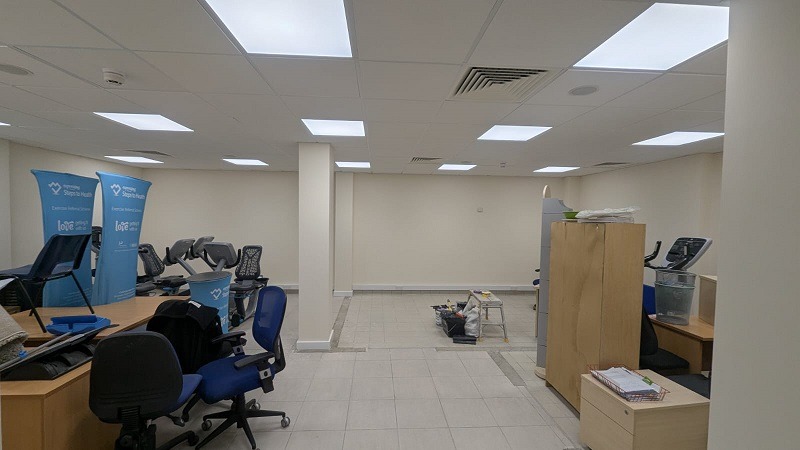
This commercial partition walls removal, office strip out, and commercial office refurbishment project took place at Crook Log Leisure Centre in Bexleyheath. Our team transformed multiple offices into a larger, fully functional space for Steps for Health. The works included ceiling installation, electrical upgrades, and new partition construction.

Project: Commercial office strip out and refurbishment to create a more open environment
Location: Crook Log Leisure Centre, Bexleyheath
Client: Steps for Health
Main Contractor: Parkwood Leisure Ltd
Service: Building Services
Sector: Leisure and public facility
Works included: Office demolition – ceiling replacement, electrical alterations, plumbing isolation, and new office partition installation
What was the commercial partition walls removal project in Bexleyheath?
Crook Log Leisure Centre in Bexleyheath, required a layout transformation within the Steps for Health area.
Previously, several small offices divided the available space and limited functionality. Therefore, the client required the removal of walls and offices to create a larger open environment.
Additionally, the project required a full office strip out and commercial office refurbishment. These works included electrical alterations, plumbing isolation, ceiling replacement, and new partition construction.
Our team completed the work during normal hours and selected out-of-hours periods. This approach reduced disruption for staff and visitors using the leisure centre.
Throughout the project, our engineers coordinated demolition, service isolation, and finishing works. Consequently, the refurbished space now supports improved accessibility and a modern working environment.


How did we prepare the site before removing the partition walls?
Careful preparation ensured safe working conditions and controlled dust throughout the project. Firstly, our team installed temporary hoarding across four offices within the Steps for Health area. The hoarding created a sealed barrier between the construction zone and the operational facility.
Additionally, we installed a builder’s access doorway to allow controlled entry to the work area. This system prevented dust migration into surrounding spaces.
Next, our engineers isolated electrical supplies to lighting and socket circuits. Following the electrical isolation, we removed light fittings and socket outlets connected to the affected walls.
Meanwhile, the team removed speakers and fire alarm components installed within the office partitions. This preparation allowed safe demolition without damaging building services.
What office strip out works formed part of the refurbishment?
The project required a complete internal strip out before the main demolition phase. First, our team removed the suspended ceilings and MF ceiling structures throughout the offices. After removal, we safely transported all waste materials downstairs to skips.
Next, we carefully removed the office door frames and stored one door for reuse. This approach reduced waste and allowed the client to reuse existing materials.
Meanwhile, our engineers isolated plumbing services within the offices. We removed two wash hand basins and cut back cold water pipework.
Importantly, we removed redundant pipework to eliminate dead-leg water sections. Our experienced engineers also isolated waste pipework to ensure safe removal.
Finally, the team removed wall tiles and mirrors before preparing surfaces for later repairs.
How did we carry out the commercial partition walls removal safely?
Once preparation finished, our engineers began the controlled demolition of the internal partition walls.
The offices contained concrete block partition walls built from floor to ceiling. Therefore, the team carefully dismantled each section to protect surrounding structures. Next, workers transported the removed blockwork downstairs to skips for disposal.
Throughout the demolition phase, we maintained strict housekeeping procedures. As a result, the work area remained organised and safe for engineers.
Following wall removal, the surrounding walls required repairs. Our team applied bonding plaster and finished the surfaces with a smooth plaster coat.
Additionally, the floor required repairs where walls previously sat between ceramic tiles. We repaired these areas using replacement tiles or sand and cement. Finally, we applied a latex finish to create a smooth base beneath the future rubber flooring.
How did we adapt ceilings and building services for the new layout?
After completing demolition, the project moved into the reinstatement phase. Our engineers installed a new suspended ceiling using 600mm by 600mm ceiling tiles.
Next, the team supplied and installed twelve new LED light fittings within the ceiling grid. These fittings improved lighting levels across the refurbished space.
Meanwhile, electricians adapted the lighting wiring to suit the revised layout. They also installed a new light switch to control the updated system.
Our professional engineers also modified the existing supply and extract ventilation ductwork. They repositioned ventilation grilles to suit the open layout. These alterations improved airflow and comfort throughout the new workspace.
How did we create a new office area behind reception?
The client also required a new office space behind the reception desk. To achieve this, our team constructed a full-height timber stud partition wall. Next, we installed insulation within the studwork to improve acoustic separation.
After insulation, we fixed plasterboard to both sides of the partition wall. Our team then taped and jointed the boards to achieve a smooth finish.
Importantly, we reused one of the previously removed office doors. The reused door included suitable hardware and door furniture. Lastly, we installed new skirting boards and painted them white to match the surrounding interior.
How did we complete finishing works and site clearance?
After construction works finished, our team completed all decorative and finishing works. Our decorators repaired minor wall imperfections across the refurbished area. Following on from this, they applied two coats of emulsion paint to all walls. This process created a fresh and professional finish throughout the Steps for Health facility.
Following decoration, our team removed the temporary hoarding. Finally, we completed a full site clean and removed all redundant materials. We transported waste to a licensed recycling and disposal facility.
What was the result of this commercial partition walls removal project?
The completed refurbishment created a modern and flexible workspace for Steps for Health. The project delivered several key benefits for the client:
- A larger open area for improved usability
- Improved lighting with new LED fittings
- Better airflow through adapted ventilation systems
- Creating a new private office behind reception
- Providing a modern and professional interior finish
Ultimately, the commercial partition walls removal transformed the internal layout and improved the functionality of the facility.
Frequently asked questions about removing partition walls
How much does it cost to remove a partition wall?
Costs vary depending on wall materials, services inside the wall, and finishing works required after removal.
Do I need permission to remove a partition wall?
Most non-structural partition walls do not require planning permission. However, building management approval may still apply in commercial buildings. The area would need to be accessed.
Are partition walls ever load-bearing?
Most office partition walls are non-load-bearing.
However, engineers should always confirm structural details before demolition begins.
Can partition walls be removed in operational buildings?
Contractors can install temporary hoarding and complete work outside normal operating hours to minimise disruption.
Why choose IDWe Ltd for commercial office refurbishment projects?
IDWe Ltd delivers professional mechanical and electrical services for commercial and industrial buildings across London and the South East.
Our experienced engineers manage commercial office refurbishment, office strip out projects, and interior demolition works.
In addition, our team coordinates electrical alterations, mechanical services, and building fabric works. This integrated approach allows us to complete refurbishment projects safely and efficiently.
Consequently, clients benefit from a single contractor managing complex building works. To get a quote, please call 020 8302 7644 or email: info@idwe.co.uk
Related Case Studies
Other projects carried out at Crook Log Leisure Centre include an Electrical Shed Rebuilt – read our Case Study.
Plus we were asked to work with the NHS to work on five room patient renovation project – read the full Case Study.
Can we help you?
If your office requires a trusted M&E Contractor in Bexleyheath. IDWe Ltd provide building refurbishment services that keep projects on schedule and within budget.
Contact us today to discuss your hotel project and discover how our expertise can support your next refurbishment.
To get a quote, please call 020 8302 7644, complete form online or email: info@idwe.co.uk
Covering London, Kent, Surrey, West Sussex, East Sussex, Middlesex and Essex.
>> Download our latest brochure to find our more.
Offering quality services for 35+ years, across London and the South East.